- Ethiopia on the World Map: Continent and Region
- Which Countries Border Ethiopia? (6 Neighboring Nations)
- Ethiopia's Size and Dimensions: Physical Size
- Why Ethiopia’s Location Matters
- How Far Is Ethiopia From Other African Destinations?
- Common Misconceptions About Ethiopia’s Location
- Frequently Asked Questions About Where Is Ethiopia Located?
Ethiopia Location on Map: Continent, Borders, Capital & Map Guide
Ethiopia sits in the Horn of Africa, in the northeastern part of the African continent. It lies roughly between 3°N and 15°N latitude and 33°E and 48°E longitude, with its capital, Addis Ababa, positioned at approximately 9.03°N, 38.74°E. Ethiopia is landlocked, sharing borders with six countries: Eritrea, Djibouti, Somalia, Kenya, South Sudan, and Sudan.
Ethiopia on the World Map: Continent and Region
Ethiopia is part of East Africa, and more specifically, the Horn of Africa — the peninsula-shaped region that juts out toward the Arabian Peninsula, separated only by the narrow Bab-el-Mandeb strait and the Red Sea. This location places Ethiopia close to some of the world's busiest shipping lanes, even though the country itself has no coastline.
Looking at a map, Ethiopia occupies a large, irregularly shaped block of territory in the northeastern interior of Africa. It's one of the largest countries on the continent by land area.
Total Area: 1,104,300 km² (426,400 sq mi) — making it slightly larger than France and Spain combined.
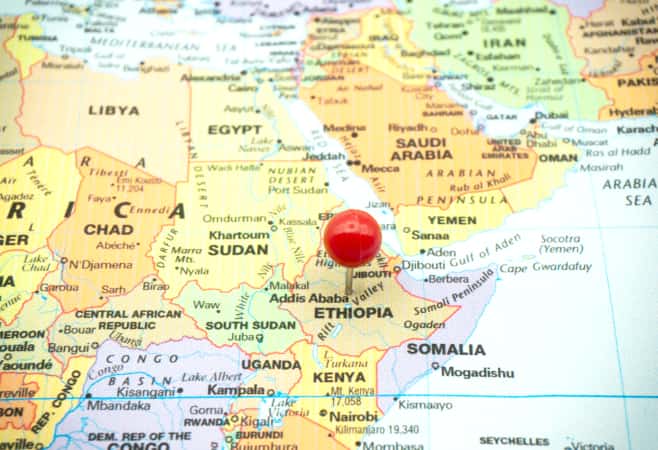 Discover where Ethiopia is on the map
Quick Facts: Where exactly is Ethiopia located?
| Attribute | Details |
| Official Name |
Federal Democratic Republic of Ethiopia |
| Region | Northeastern Africa, Horn of Africa |
| GPS Coordinates | 9.1450° N, 40.4897° E |
| Latitude | 3° to 14.8° N (Northern Hemisphere) |
| Longitude | 33° to 48° E (Eastern Hemisphere) |
| Capital City | Addis Ababa (9°02' N, 38°42' E) |
| Total Area | 1,104,300 km² (426,400 sq mi) |
| Country Size Rank | 26th largest country globally |
|
Landlocked Status |
Yes – most populous landlocked country worldwide |
Addis Ababa itself sits at a notably high elevation — around 2,355 meters (7,726 feet) above sea level — making it one of the highest capital cities in the world.
Which Countries Border Ethiopia? (6 Neighboring Nations)
Ethiopia shares land borders with six neighboring countries. This makes Ethiopia one of the most "boxed in" countries in Africa in terms of neighbors, which is part of why its access to ports in Djibouti has become so strategically important for trade.
Ethiopia is landlocked, surrounded by six African countries with no direct ocean access.
| Border Direction | Country | Key Details |
| North | Eritrea |
Formerly federated with and later incorporated into Ethiopia, it became an independent state in 1993. |
| Northeast | Djibouti |
Small nation, gateway to the Red Sea |
| East & Southeast | Somalia | Long border along the Horn of Africa |
| South | Kenya | Direct southern neighbor |
| West & Northwest | Sudan |
The largest western border |
| Southwest | South Sudan | Border established in 2011 |
Addis Ababa's central location within Africa, combined with Ethiopian Airlines' extensive network, has made it one of the continent's busiest aviation hubs and a common stopover point between Europe, Asia, and the rest of Africa.
Ethiopia's Size and Dimensions: Physical Size
|
Measurement |
Value |
| Total Area |
1,104,300 km² (426,400 sq mi) |
| Alternative Area |
432,432 sq mi (1,120,000 sq km) |
| Length |
Approximately 1,018 miles (1,638 km) |
| Width |
Approximately 980 miles (1,577 km) |
| Global Size Rank |
26th largest country |
Geographic Features
Ethiopia has one of the most rugged and complex topographies in Africa:
- Ethiopian Plateau: Dominates the central region
- Highlands: Significant elevation variations
- Rivers: Includes the Blue Nile (source)
Is Ethiopia Landlocked?
Yes. Ethiopia is landlocked, and has been since Eritrea's independence in 1993, which cut off Ethiopia's former access to the Red Sea coastline. Today, the vast majority of Ethiopia's import and export trade flows through the Port of Djibouti, connected to Addis Ababa via road and the Addis Ababa–Djibouti railway. This landlocked status remains one of the defining features of Ethiopia's geography and has shaped much of its trade and foreign policy in recent years.
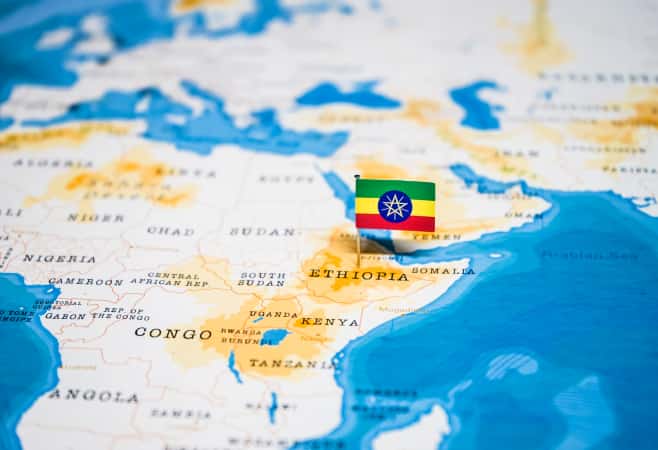 Explore Ethiopia's location in Africa, neighboring countries, and landlocked status
Why Ethiopia’s Location Matters
Strategic Trade and Connectivity — Positioned between the Red Sea/Gulf of Aden routes and inner Africa, it’s a natural corridor.
Climate Diversity — From alpine-like highlands to arid lowlands, supporting varied agriculture (famous for coffee, for example).
Historical Significance — One of the world’s oldest independent nations, never fully colonized, with ancient roots in the Kingdom of Aksum.
Regional Influence — As the seat of the African Union headquarters in Addis Ababa, Ethiopia plays a leading diplomatic role on the continent.
How Far Is Ethiopia From Other African Destinations?
Ethiopia's central position in East Africa makes it accessible from many popular destinations. Approximate flight times from Addis Ababa include:
- Nairobi, Kenya: ~1,160 km (about 2 hours by air)
- Kigali, Rwanda: about 2.5 hour by air
- Dubai, UAE: ~2,400 km (about 3.5 hours by air)
- Cairo, Egypt: ~2,900 km (about 4 hours by air)
- Johannesburg, South Africa: ~3,950 km (about 5 hours by air)
- Istanbul, Türkiye: ~3,700 km (about 5 hours by air)
 Discover why Ethiopia's geographic position is important
Common Misconceptions About Ethiopia’s Location
Myth 1: "Ethiopia is near the Middle East."
True only in a relative sense. The Red Sea is 60 km from Ethiopia’s northeast border at its closest point. Yemen is about 300 km across the water. Culturally, Ethiopia has ancient ties to Arabia (coffee origin, Semitic languages), but geographically, it’s firmly in Africa.
Myth 2: "Ethiopia is landlocked and has no water access."
Landlocked – yes. No access – false. Ethiopia uses Djibouti’s Port of Doraleh for 95% of its sea trade. Also has port agreements with Berbera (Somaliland) and even Port Sudan.
Myth 3: "Ethiopia is tiny."
Wrong. It’s the 26th largest country globally – bigger than Peru, South Africa, or Spain. Ethiopia covers roughly twice the area of metropolitan France and is slightly larger than Egypt (1.1M km² vs Egypt’s 1.0M km²).
Frequently Asked Questions About Where Is Ethiopia Located?
What continent is Ethiopia in?
Ethiopia is in Africa, specifically in the eastern part of the continent, within the Horn of Africa subregion.
Is Ethiopia in the Middle East or Africa?
Ethiopia is entirely within Africa. While it sits close to the Arabian Peninsula across the Red Sea, it is not considered part of the Middle East.
What countries are near Ethiopia?
Ethiopia borders Eritrea, Djibouti, Somalia, Kenya, South Sudan, and Sudan, placing it at the center of the Horn of Africa.
What is the closest ocean to Ethiopia?
The Red Sea (via Djibouti) and the Indian Ocean, via the Gulf of Aden, are the nearest bodies of water, though Ethiopia has no direct coast. The closest shoreline is Djibouti’s coast – only 60 km from Ethiopia’s border.
Is Ethiopia a coastal country?
No, Ethiopia is completely landlocked with no direct access to the ocean.
What is the capital of Ethiopia, and where is it located?
The capital is Addis Ababa, located in the central highlands of Ethiopia at coordinates approximately 9.03°N, 38.74°E, at an elevation of over 2,300 meters.
Is Ethiopia a hot country?
Yes, Ethiopia lies completely within tropical latitudes, creating generally warm temperatures with variations due to elevation.
Related Articles
- Arba Minch Conference Resort Opens in Ethiopia with 1,300+ Capacity Venue
- Ethiopian Culture and Traditions: History, Food, Music & Customs
- Ethiopia Entry & Quarantine Requirements: What Travelers Should Know
- Eid al-Adha in Ethiopia: Holiday Dates, Celebrations & Travel Tips
- Nigeria to Ethiopia Travel Guide: Flights, Visa, Routes & Essential Tips
- Bringing Pets to Ethiopia: Requirements & Travel Guide
- Sunrise and Sunset in Addis Ababa: Times & Best Viewing Spots
- How to Travel from Egypt to Ethiopia: Routes and Costs
- Can You Use eSIM in Ethiopia? Best Options for Tourists


