- What Makes Ethiopian Culture Unique?
- Ethiopian Hospitality
- Traditional Ethiopian Greetings
- Religion in Ethiopia
- Ethiopian Coffee Ceremony
- Ethiopian Food Traditions
- Traditional Ethiopian Clothing
- Music and Dance
- Ethiopian Major Festivals and Celebrations
- Family Values in Ethiopian Society
- Traditional Weddings
- Cultural Etiquette for Travelers
- UNESCO World Heritage Sites
- Cultural Differences Travelers Should Know
- Travel Tips for Experiencing Ethiopian Culture
- Key Takeaways
- Frequently Asked Questions About Ethiopia Culture and Traditions
Ethiopian Culture and Traditions: History, Food, Music & Customs
Ethiopia is one of Africa's oldest civilizations, with a cultural heritage that spans more than 3,000 years. Home to over 80 ethnic groups, numerous languages, and diverse religious communities, the country offers a rich tapestry of traditions that continue to shape daily life.
For travelers, understanding Ethiopian culture and traditions can enhance every aspect of the journey—from participating in a traditional coffee ceremony to respecting local customs at churches, markets, and family gatherings.
This guide explores Ethiopia's cultural identity, traditional practices, festivals, etiquette, cuisine, and practical tips for international visitors.
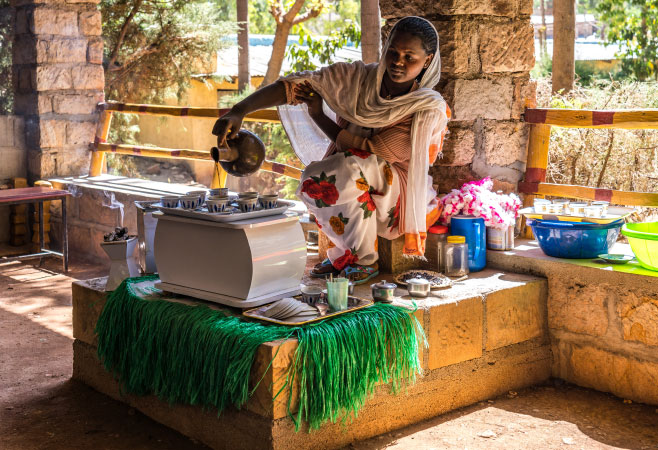 A traditional coffee ceremony in Ethiopia
What Makes Ethiopian Culture Unique?
Ethiopia’s cultural identity reflects centuries of continuity alongside remarkable ethnic, linguistic, and religious diversity. Distinctive traditions include the ancient Ge’ez liturgical heritage, Ethiopian Orthodox Christianity, longstanding Islamic communities, regional music and dance traditions, and a food culture built around dishes such as injera. Several characteristics make Ethiopian culture unique:
- One of the world's oldest Christian traditions
- Rich Islamic heritage dating back to the 7th century
- Diverse ethnic cultures and languages
- Ancient Ge'ez script and liturgical traditions
- Distinctive cuisine centered around injera
- World-famous coffee ceremonies
- Vibrant music and dance traditions
- Strong emphasis on hospitality and community
These influences combine to create a cultural experience unlike any other in Africa.
Ethiopian Hospitality
Hospitality is one of the most valued aspects of Ethiopian society.
Guests are often welcomed warmly and offered:
- Coffee
- Tea
- Traditional meals
- Fresh fruit
- Conversation before business
Accepting these gestures is generally viewed as respectful and helps build relationships.
When invited into someone's home:
- Remove your shoes if requested.
- Greet everyone individually.
- Wait for the host to begin the meal.
- Thank the host before leaving.
Traditional Ethiopian Greetings
Greetings play an important role in everyday interactions.
Common practices include:
- Handshakes using the right hand
- Asking about family and well-being before discussing business
- Respectful greetings toward elders
- Extended conversations among friends and relatives
- The right hand is traditionally used for greeting, eating, and exchanging items.
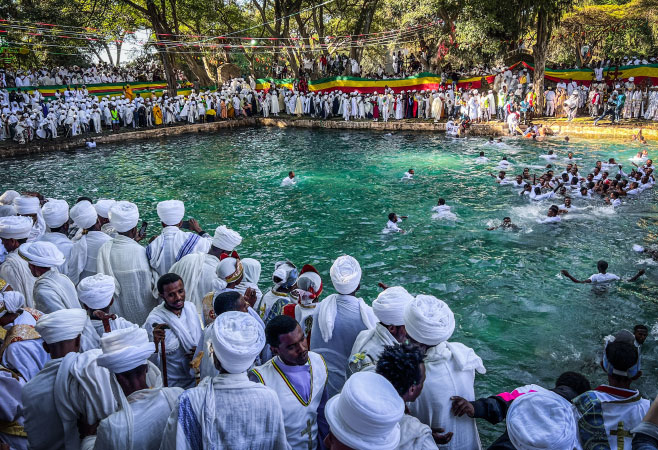 Ethiopian cultural and religious traditions brought to life during a traditional ceremony
Religion in Ethiopia
Religion shapes daily life, architecture, festivals, and etiquette across the country:
Ethiopian Orthodox Tewahedo Christianity — the largest single faith, with roots dating to the 4th century, centered on ancient churches, fasting periods, and elaborate festivals
Islam — a large and long-established population, particularly in the east (notably the historic walled city of Harar)
Protestant Christianity — a growing share of the population, especially in southern regions
Traditional and indigenous beliefs — practiced by various ethnic communities, particularly in the Omo Valley
For visitors:
Modest dress is expected at religious sites — cover shoulders and knees, and remove shoes before entering churches and mosques. Fasting periods (the Ethiopian Orthodox Church observes some of the longest fasting calendars of any Christian tradition) affect food availability at certain times of year, though most restaurants in tourist areas offer both fasting (vegan) and non-fasting menus.
Ethiopian Coffee Ceremony
One of Ethiopia's most famous cultural traditions is the coffee ceremony, which symbolizes friendship, hospitality, and community.
Coffee is believed to have originated in Ethiopia, and the ceremony remains an important social ritual.
A traditional ceremony involves:
- Washing green coffee beans.
- Roasting the beans over charcoal.
- Grinding them by hand.
- Brewing the coffee in a clay pot called a jebena.
- Serving three rounds of coffee, each with its own symbolic significance.
The ceremony may last an hour or longer and encourages conversation among family members and guests.
If you are invited to a coffee ceremony, allow plenty of time and follow your host’s lead. The ceremony can include several rounds and is often as much about conversation as the coffee itself.
Ethiopian Food Traditions
Food is central to Ethiopian family life and celebrations.
Injera
The country's signature food is injera, a soft, fermented flatbread traditionally made from teff flour. It serves as both:
- The plate
- The utensil
Food is placed on top of the injera, and diners use pieces of bread to scoop up various dishes.
Popular Ethiopian Dishes
Common meals include:
- Doro Wat (spicy chicken stew)
- Tibs (sautéed meat)
- Shiro (chickpea stew)
- Misir Wat (lentil stew)
- Kitfo (seasoned minced beef, often served raw or lightly cooked)
- Gomen (collard greens)
Many Ethiopian meals are naturally vegetarian or vegan, especially during Orthodox Christian fasting periods.
Eating Etiquette
Traditional dining customs include:
- Eating with the right hand
- Sharing food from a communal platter
- Waiting until elders or hosts begin eating
- Offering food to others as a sign of affection and respect
One well-known tradition is gursha, where one person feeds another by hand to express friendship, generosity, or celebration. Visitors are not expected to participate but may politely accept if they feel comfortable.
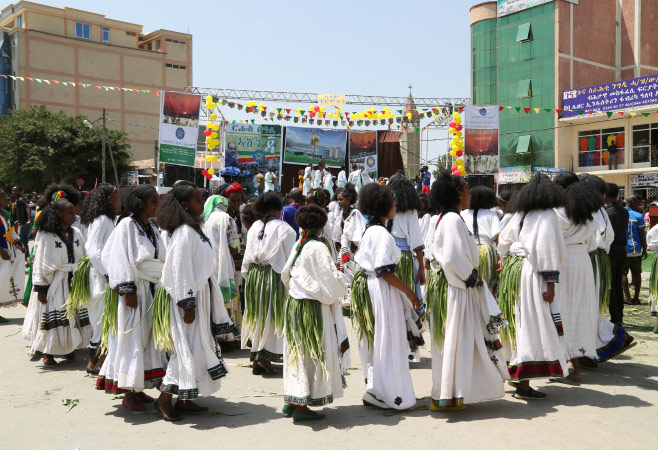 A group of women in traditional white Habesha dresses during a cultural or religious festival celebration in Ethiopia
Traditional Ethiopian Clothing
Traditional attire is often worn during holidays, weddings, festivals, and religious celebrations.
Women's Clothing
The Habesha kemis, a long white dress often decorated with woven or embroidered borders, is one of Ethiopia’s best-known traditional garments. Clothing traditions vary widely among the country’s ethnic and regional communities.
Men's Clothing
Men often wear:
- White cotton garments
- Shawls
- Traditional cloaks during ceremonies
Although Western clothing is common in cities, traditional dress remains an important symbol of cultural identity.
Music and Dance
Music plays an essential role in Ethiopian celebrations.
Traditional instruments include:
- Krar (lyre)
- Masenqo (single-string fiddle)
- Kebero (drum)
- Washint (bamboo flute)
Different ethnic communities have distinctive dance styles.
One of the best-known is the Eskista, characterized by expressive shoulder and upper-body movements.
Music is central to:
- Weddings
- Religious festivals
- Cultural celebrations
- Family gatherings
Ethiopian Major Festivals and Celebrations
| Festival | Ethiopian Significance | Approx. Date |
|---|---|---|
| Enkutatash (New Year) | Marks the Ethiopian New Year; families gather, homes are decorated with Meskel daisies (Adey Abeba) | September 11 (12 in leap years) |
| Meskel | Commemorates the finding of the True Cross; marked by large bonfires (demera) and processions | September 27 |
| Timkat (Epiphany) | Reenacts the baptism of Jesus; colorful processions with replica Arks of the Covenant, among Ethiopia's most spectacular public events | January 19 (20 in leap years) |
| Genna (Ethiopian Christmas) | Orthodox Christmas, marked by church services and traditional games | January 7 |
| Irreecha | Oromo thanksgiving festival tied to the Gadaa system, celebrated at lakesides and hilltops | Late September/early October |
| Fichee-Chambalaalla | Sidama New Year festival, centered on family visits and shared meals | Varies (astrologically determined) |
Timkat, Meskel, the Gada system, and Fichee-Chambalaalla are among Ethiopia’s cultural traditions inscribed on UNESCO’s Representative List of the Intangible Cultural Heritage of Humanity.
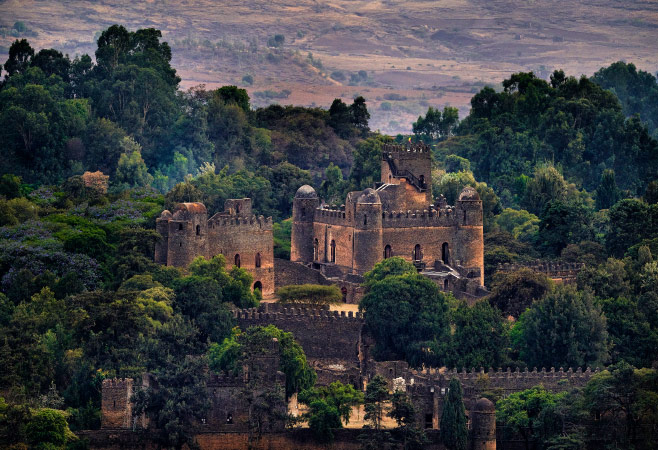
The Fasil Ghebbi royal fortress complex in Gondar, Ethiopia, is a striking reminder of Ethiopia's architectural heritage and centuries-old history
Family Values in Ethiopian Society
Family is at the heart of Ethiopian culture.
Characteristics include:
- Strong respect for elders
- Close relationships across generations
- Shared responsibility for children
- Community support during celebrations and hardships
- Frequent family gatherings
Decisions are often made collectively, especially in rural communities.
Traditional Weddings
Ethiopian weddings vary among ethnic groups and religions but often include
- Religious ceremonies
- Traditional music
- Dancing
- Large community celebrations
- Colorful traditional clothing
- Multi-course feasts
Many weddings involve hundreds of guests and may last an entire day or longer.
Cultural Etiquette for Travelers
Respecting local customs can help visitors build positive relationships.
Dress Modestly
When visiting:
Churches
- Mosques
- Rural communities
Wear clothing that covers the shoulders and knees.
Ask Before Taking Photos
Ask before photographing people, ceremonies, or community activities. Do not photograph military personnel, military areas, sensitive government locations, or places displaying photography restrictions.
Respect Religious Sites
When entering churches or mosques:
- Dress appropriately.
- Speak quietly.
- Follow any footwear or head-covering requirements.
Observe local customs regarding photography and movement within the site.
Use the Right Hand
The right hand is traditionally used for:
- Eating
- Greeting
- Giving and receiving items
Using the left hand alone may be considered impolite in some settings
UNESCO World Heritage Sites
Ethiopia is home to 12 UNESCO World Heritage properties, making it one of Africa’s most significant destinations for cultural and natural heritage:
- Rock-Hewn Churches of Lalibela — 11 medieval churches carved directly into volcanic rock
- Aksum — ancient obelisks and ruins from one of history's great early civilizations
- Fasil Ghebbi (Gondar) — 17th-century royal castles, sometimes called "Africa's Camelot"
- Harar Jugol — a walled Islamic city with many historic mosques
- Simien Mountains National Park — dramatic highland scenery and endemic wildlife
- Lower Valley of the Awash — an important paleoanthropological region that includes Hadar, where the famous 3.2-million-year-old Australopithecus afarensis fossil known as Lucy was discovered.
- Lower Valley of the Omo — another major paleoanthropological site that has contributed important evidence to the study of human evolution.
For culturally focused travelers, these sites offer a tangible way to experience the history behind the living traditions described above.
Cultural Differences Travelers Should Know
| Topic | Ethiopian Custom |
|---|---|
| Greetings | Warm, often lengthy, and personal |
| Meals | Shared from a communal platter |
| Hospitality | Guests are treated with great respect |
| Coffee | Ceremony symbolizes friendship and community |
| Family | Extended family plays an important role |
| Religion | Strong influence on daily life and public holidays |
| Time | Schedules may be more flexible in some social settings |
Travel Tips for Experiencing Ethiopian Culture
- Attend a traditional coffee ceremony if invited.
- Try regional dishes beyond the well-known classics.
- Visit local markets to experience everyday life.
- Learn basic greetings in Amharic.
- Dress respectfully when visiting religious sites.
- Support local artisans by purchasing authentic handmade crafts.
- Be patient and embrace opportunities for conversation—social interactions are often valued as much as the destination itself.
Key Takeaways
Ethiopia’s cultural traditions vary considerably by region and community, so observation and respect matter more than memorizing a fixed set of rules. Dress appropriately at religious sites, ask before photographing people, and follow local hosts or guides when you are unsure about etiquette.
Frequently Asked Questions About Ethiopia Culture and Traditions
What is Ethiopia best known for culturally?
Ethiopia is renowned for its ancient history, coffee culture, distinctive cuisine, religious traditions, diverse ethnic communities, and UNESCO World Heritage sites.
Why is the Ethiopian coffee ceremony important?
The coffee ceremony represents hospitality, friendship, and social connection. It is a cherished tradition that brings family members, neighbors, and guests together for conversation and community.
Is Ethiopia culturally diverse?
Yes. Ethiopia is one of Africa's most culturally diverse countries, with more than 80 ethnic groups, numerous languages, and a wide variety of traditions, music, clothing, and cuisines.
What are the most important Ethiopian festivals?
The most important festivals include Enkutatash, Meskel, Timkat, and Genna.
What should tourists know about Ethiopian etiquette?
Tourists should greet people politely, respect elders, dress modestly in religious places, and follow local dining customs.
Why is Ethiopia culturally unique?
Ethiopia is culturally unique because it has preserved ancient traditions, a distinctive calendar, major religious festivals, and a strong sense of national identity across many ethnic groups.
When is the best time to visit Ethiopia for cultural festivals?
January and September are popular months for major celebrations. Timkat and Genna take place in January, while Enkutatash and Meskel fall in September. Check the dates for your travel year before planning, as calendar conversions and individual festival schedules can vary.
Related Articles
- Arba Minch Conference Resort Opens in Ethiopia with 1,300+ Capacity Venue
- Ethiopia Entry & Quarantine Requirements: What Travelers Should Know
- Eid al-Adha in Ethiopia: Holiday Dates, Celebrations & Travel Tips
- Ethiopia Location on Map: Continent, Borders, Capital & Map Guide
- Nigeria to Ethiopia Travel Guide: Flights, Visa, Routes & Essential Tips
- Bringing Pets to Ethiopia: Requirements & Travel Guide
- Sunrise and Sunset in Addis Ababa: Times & Best Viewing Spots
- How to Travel from Egypt to Ethiopia: Routes and Costs
- Can You Use eSIM in Ethiopia? Best Options for Tourists


